United States History · Chapter 11
11. A Nation on the Move: Westward Expansion, 1800–1860
The United States expanded westward from 1800 to 1860, driven by a belief in manifest destiny, leading to significant events like the Louisiana Purchase, the annexation of Texas, and the Mexican-American War. Key figures such as Lewis and Clark explored the new territories, while the Missouri Crisis highlighted tensions over slavery's expansion. The Texas War for Independence resulted in Texas becoming a republic, and the subsequent Mexican-American War led to the U.S. acquiring vast territories, including California, which sparked the Gold Rush. The Wilmot Proviso and the Compromise of 1850 further intensified the national debate over slavery, revealing deepening sectional divides.
Learning Objectives
By the end of this chapter, you will be able to:
- Explain the significance of the Louisiana Purchase
- Describe the terms of the Adams-Onís Treaty
- Describe the role played by the filibuster in American expansion
- Explain why the North and South differed over the admission of Missouri as a state
- Explain how the admission of new states to the Union threatened to upset the balance between free and slave states in Congress
- Explain why American settlers in Texas sought independence from Mexico
- Discuss early attempts to make Texas independent of Mexico
- Describe the relationship between Anglo-Americans and Tejanos in Texas before and after independence
- Identify the causes of the Mexican-American War
- Describe the outcomes of the war in 1848, especially the Mexican Cession
- Describe the effect of the California Gold Rush on westward expansion
- Describe the terms of the Wilmot Proviso
- Discuss why the Free-Soil Party objected to the westward expansion of slavery
- Explain why sectional and political divisions in the United States grew
- Describe the terms of the Compromise of 1850
Introduction#
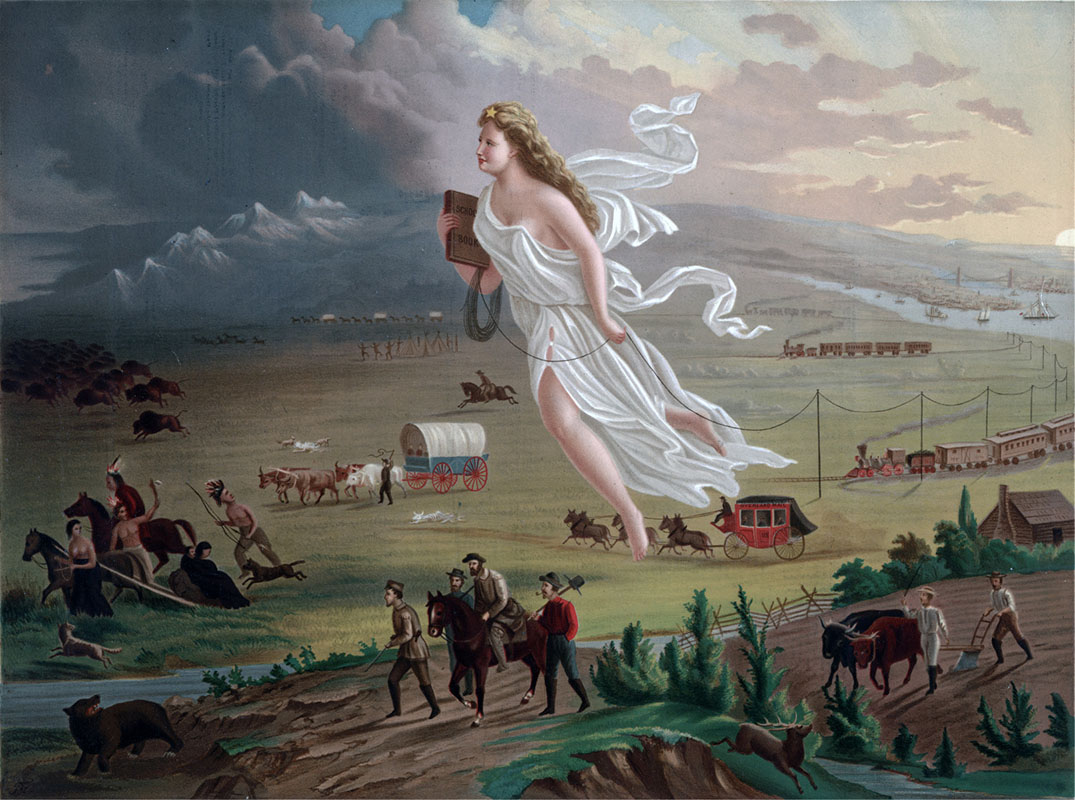
Figure 11.1 In the first half of the nineteenth century, settlers began to move west of the Mississippi River in large numbers. In John Gast’s American Progress (ca. 1872), the figure of Columbia, representing the United States and the spirit of democracy, makes her way westward, literally bringing light to the darkness as she advances.
After 1800, the United States militantly expanded westward across North America, confident of its right and duty to gain control of the continent and spread the benefits of its “superior” culture. In John Gast’s American Progress (Figure 11.1), the white, blonde figure of Columbia—a historical personification of the United States—strides triumphantly westward with the Star of Empire on her head. She brings education, symbolized by the schoolbook, and modern technology, represented by the telegraph wire. White settlers follow her lead, driving the helpless natives away and bringing successive waves of technological progress in their wake. In the first half of the nineteenth century, the quest for control of the West led to the Louisiana Purchase, the annexation of Texas, and the Mexican-American War. Efforts to seize western territories from native peoples and expand the republic by warring with Mexico succeeded beyond expectations. Few nations ever expanded so quickly. Yet, this expansion led to debates about the fate of slavery in the West, creating tensions between North and South that ultimately led to the collapse of American democracy and a brutal civil war.