United States History · Chapter 28
28. Post-War Prosperity and Cold War Fears, 1945-1960
The post-war era from 1945 to 1960 was marked by American fears of Communism, leading to significant political and social changes. The GI Bill aided veterans' reintegration, while Truman's Fair Deal aimed to expand social welfare. The Cold War emerged as the U.S. and Soviet Union clashed ideologically, prompting policies like containment and the Truman Doctrine to support nations resisting Communism. Eisenhower's presidency saw economic growth and suburbanization, alongside the rise of rock and roll as a cultural force. The civil rights movement gained momentum, challenging segregation and discrimination, highlighted by events such as the Montgomery Bus Boycott and the integration of schools.
Learning Objectives
By the end of this chapter, you will be able to:
- Identify the issues that the nation faced during demobilization
- Explain the goals and objectives of the Truman administration
- Evaluate the actions taken by the U.S. government to address the concerns of returning veterans
- Explain how and why the Cold War emerged in the wake of World War II
- Describe the steps taken by the U.S. government to oppose Communist expansion in Europe and Asia
- Discuss the government’s efforts to root out Communist influences in the United States
- Describe President Dwight D. Eisenhower’s domestic and foreign policies
- Discuss gender roles in the 1950s
- Discuss the growth of the suburbs and the effect of suburbanization on American society
- Describe Americans’ different responses to rock and roll music
- Discuss the way contemporary movies and television reflected postwar American society
- Explain how Presidents Truman and Eisenhower addressed civil rights issues
- Discuss efforts by African Americans to end discrimination and segregation
- Describe southern whites’ response to the civil rights movement
Introduction#
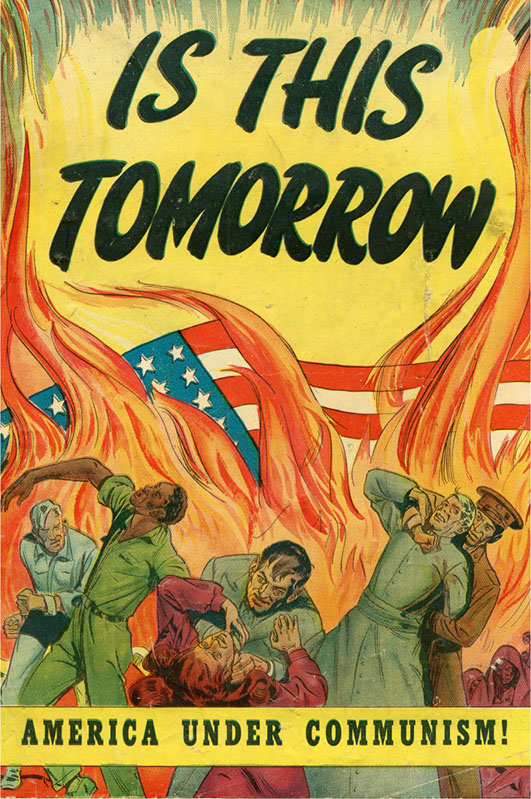
Is This Tomorrow? (Figure 28.1), a 1947 comic book, highlights one way that the federal government and some Americans revived popular sentiment in opposition to Communism. The United States and the Soviet Union, allies during World War II, had different visions for the postwar world. As Joseph Stalin, premier of the Soviet Union, tightened his grip on the countries of Eastern Europe, Americans began to fear that it was his goal to spread the Communist revolution throughout the world and make newly independent nations puppets of the Soviet Union. To enlist as many Americans as possible in the fight against Soviet domination, the U.S. government and purveyors of popular culture churned out propaganda intended to convince average citizens of the dangers posed by the Soviet Union. Artwork such as the cover of Is This Tomorrow?, which depicts Russians attacking Americans, including a struggling woman and an African American veteran still wearing his uniform, played upon postwar fears of Communism and of a future war with the Soviet Union. These fears dominated American life and affected foreign policy, military strategy, urban planning, popular culture, and the civil rights movement.