United States History · Chapter 21
21. Leading the Way: The Progressive Movement, 1890-1920
The Progressive Movement from 1890 to 1920 was characterized by various reforms aimed at addressing social issues such as women's suffrage, labor rights, and political corruption. Muckrakers played a crucial role in exposing societal problems, leading to grassroots activism for reforms like direct primaries, initiatives, and referendums. Key figures included Theodore Roosevelt, who championed the Square Deal and antitrust actions, and Woodrow Wilson, who promoted the New Freedom agenda. The era also saw the emergence of significant movements for women's rights and civil rights for African Americans, highlighting the diverse strategies and goals within the broader Progressive framework.
Learning Objectives
By the end of this chapter, you will be able to:
- Describe the role that muckrakers played in catalyzing the Progressive Era
- Explain the main features of Progressivism
- Identify specific examples of grassroots Progressivism relating to the spread of democracy, efficiency in government, and social justice
- Describe the more radical movements associated with the Progressive Era
- Understand the origins and growth of the women’s rights movement
- Identify the different strands of the early African American civil rights movement
- Explain the key features of Theodore Roosevelt’s “Square Deal”
- Explain the key features of William Howard Taft’s Progressive agenda
- Identify the main pieces of legislation that Woodrow Wilson’s “New Freedom” agenda comprised
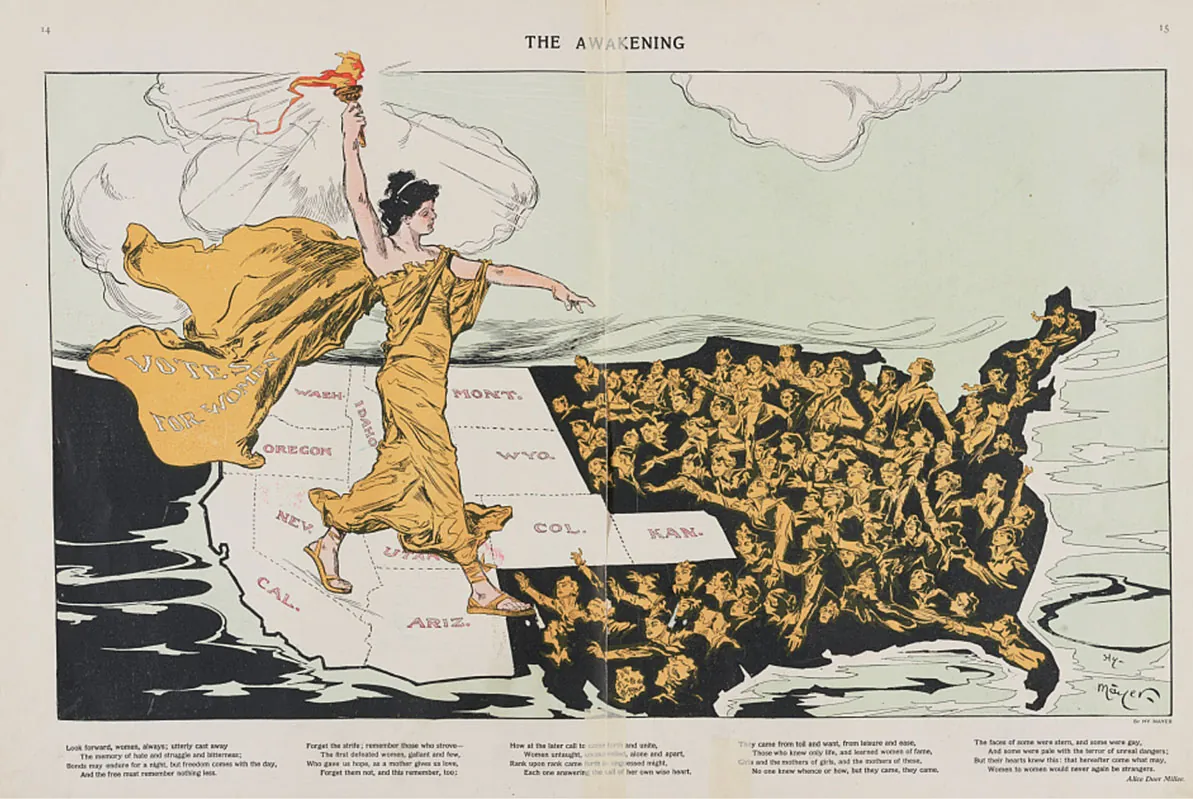
Women’s suffrage was one of many causes that emerged in the Progressive Era, as Americans confronted the numerous challenges of the late nineteenth century. Starting in the late 1800s, women increasingly were working outside the home—a task almost always done for money, not empowerment—as well as pursuing higher education, both at universities that were beginning to allow women to enroll and at female-only schools. Often, it was educated middle-class women with more time and resources that took up causes such as child labor and family health. As more women led new organizations or institutions, such as the settlement houses, they grew to have a greater voice on issues of social change. By the turn of the century, a strong movement had formed to advocate for a woman’s right to vote. For three decades, suffragist groups pushed for legislation to give women the right to vote in every state. As the illustration above shows (Figure 21.1), the western states were the first to grant women the right to vote; it would not be until 1920 that the nation would extend that right to all women.