United States History · Chapter 22
22. Age of Empire: American Foreign Policy, 1890-1914
The chapter discusses the evolution of American foreign policy from 1890 to 1914, highlighting the influence of figures like Frederick Jackson Turner and Alfred Thayer Mahan in promoting expansionism. It covers the transition from isolationism to imperialism, marked by the Spanish-American War, which established the U.S. as a global military power. The chapter also examines economic motivations for expansion, the Open Door Policy in China, and Roosevelt's "Big Stick" diplomacy, culminating in Taft's "Dollar Diplomacy" that emphasized economic influence over military intervention.
Learning Objectives
By the end of this chapter, you will be able to:
- Explain the evolution of American interest in foreign affairs from the end of the Civil War through the early 1890s
- Identify the contributions of Frederick Jackson Turner and Alfred Thayer Mahan to the conscious creation of an American empire
- Explain the origins and events of the Spanish-American War
- Analyze the different American opinions on empire at the conclusion of the Spanish-American War
- Describe how the Spanish-American War intersected with other American expansions to solidify the nation’s new position as an empire
- Explain how economic power helped to expand America’s empire in China
- Describe how the foreign partitioning of China in the last decade of the nineteenth century influenced American policy
- Explain the meaning of “big stick” foreign policy
- Describe Theodore Roosevelt’s use of the “big stick” to construct the Panama Canal
- Explain the role of the United States in ending the Russo-Japanese War
- Explain how William Howard Taft used American economic power to protect the nation’s interests in its new empire
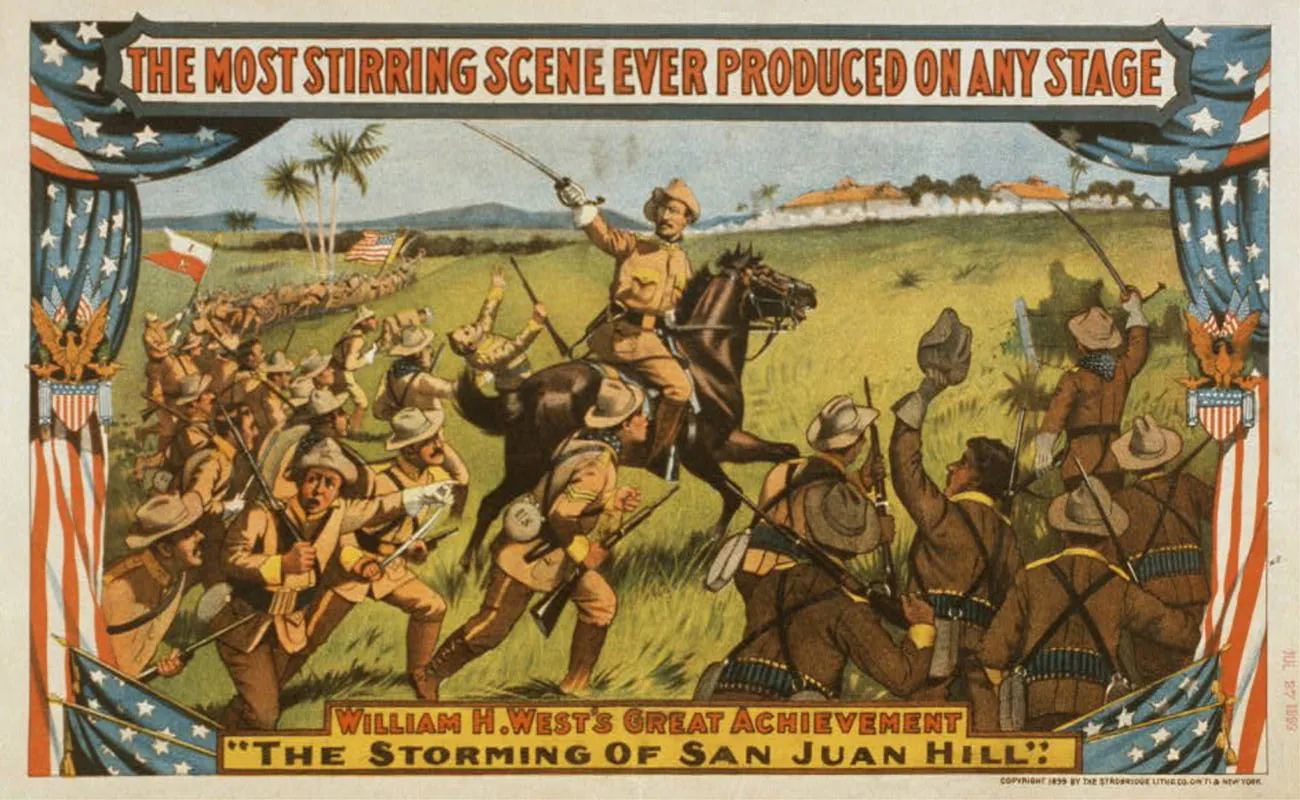
Figure 22.1 This poster advertises a minstrel show wherein an actor playing Theodore Roosevelt reenacts his leadership of the Rough RidersTheodore Roosevelt’s cavalry unit, which fought in Cuba during the Spanish-American War in the Spanish-American War and illustrates the American public’s zeal for tales of American expansionist glory.
As he approached the rostrum to speak before historians gathered in Chicago in 1893, Frederick Jackson Turner appeared nervous. He was presenting a conclusion that would alarm all who believed that westward expansion had fostered the nation’s principles of democracy. His conclusion: The frontier—the encounter between European traditions and the native wilderness—had played a fundamental role in shaping American character, but the American frontier no longer existed. Turner’s statement raised questions. How would Americans maintain their unique political culture and innovative spirit in the absence of the frontier? How would the nation expand its economy if it could no longer expand its territory?
Later historians would see Turner’s Frontier Thesisan idea proposed by Fredrick Jackson Turner, which stated that the encounter of European traditions and a native wilderness was integral to the development of American democracy, individualism, and innovative character as deeply flawed, a gross mischaracterization of the West. But the young historian’s work greatly influenced politicians and thinkers of the day. Like a muckraker, Turner exposed the problem; others found a solution by seeking out new frontiers in the creation of an American empire. The above advertisement for a theater reenactment of the Spanish-American War (Figure 22.1) shows the American appetite for expansion. Many Americans felt that it was time for their nation to offer its own brand of international leadership and dominance as an alternative to the land-grabbing empires of Europe.