United States History · Chapter 24
24. The Jazz Age: Redefining the Nation, 1919-1929
The chapter outlines the dynamic 1920s, highlighting economic prosperity that spurred mass production, the rise of movies, sports, automobiles, and radio, and the flourishing of jazz, flappers, and new cultural norms. It examines social tensions such as nativism, the resurgence of the KKK, and Prohibition’s impact, while also covering the Harlem Renaissance, the “New Negro,” and the Lost Generation’s literary response. The political narrative focuses on Republican dominance, detailing Harding’s “return to normalcy” and Coolidge’s business‑focused governance. Overall, it presents a decade of rapid technological, cultural, and political change marked by both exuberant innovation and significant backlash.
Learning Objectives
By the end of this chapter, you will be able to:
- Discuss the role of movies in the evolution of American culture
- Explain the rise of sports as a dominant social force
- Analyze the ways in which the automobile, especially the Model T, transformed American life
- Define nativism and analyze the ways in which it affected the politics and society of the 1920s
- Describe the conflict between urban Americans and rural fundamentalists
- Explain the issues in question in the Scopes trial
- Explain the factors that shaped the new morality and the changing role of women in the United States during the 1920s
- Describe the “new Negro” and the influence of the Harlem Renaissance
- Analyze the effects of prohibition on American society and culture
- Describe the character and main authors of the Lost Generation
- Discuss Warren G. Harding’s strengths and weaknesses as president
- Explain how Calvin Coolidge was able to defeat the Democratic Party
- Explain what Calvin Coolidge meant by “the business of America is business”
Introduction#
Following the hardships of the immediate postwar era, the United States embarked upon one of the most prosperous decades in history. Mass production, especially of the automobile, increased mobility and fostered new industries. Unemployment plummeted as businesses grew to meet this increased demand. Cities continued to grow and, according to the [[1920 census]], a majority of the population lived in urban areas of twenty-five hundred or more residents.
Jazz music, movies, speakeasies, and new dances dominated the urban evening scene. Recent immigrants from southern and eastern Europe, many of them Catholic, now participated in the political system. This challenged rural Protestant fundamentalism, even as quota laws sought to limit new immigration patterns. The [[Ku Klux Klan]] rose to greater power, as they protested not only the changing role of African Americans but also the growing population of immigrant, Catholic, and Jewish Americans.
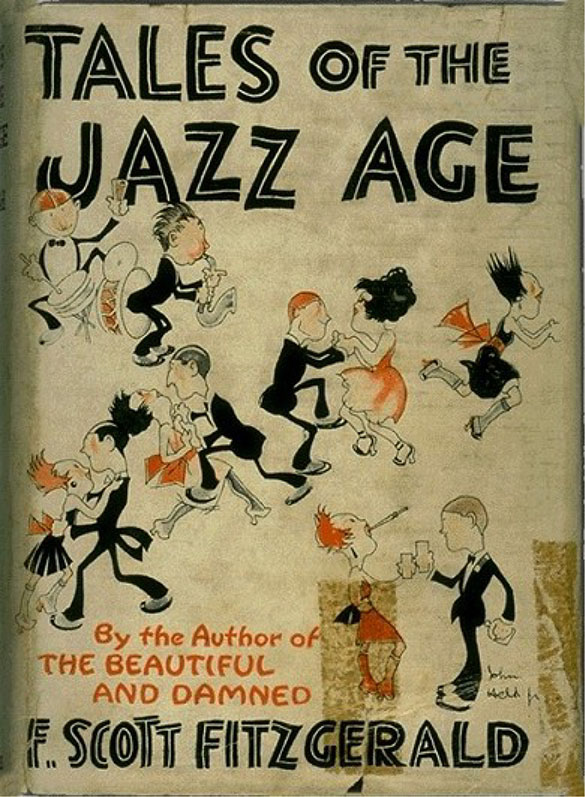
This mixture of social, political, economic, and cultural change and conflict gave the decade the nickname the “Roaring Twenties” or the “Jazz Age.” The above illustration (Figure 24.1), which graced the cover of [[F. Scott Fitzgerald]]’s [[Tales of the Jazz Age]], embodies the popular view of the 1920s as a nonstop party, replete with dancing, music, flappers, and illegal drinking.