United States History · Chapter 7
7. Creating Republican Governments, 1776–1790
After the Revolutionary War, the new United States grappled with the contradictions of freedom and slavery while establishing republican governments. Key figures like Thomas Paine and Benjamin Franklin influenced the shift from monarchy to republicanism, emphasizing the need for civic virtue and property ownership as measures of individual worth. Women's roles remained limited, but figures like Abigail Adams and Judith Sargent Murray began advocating for legal equality and education. The Constitution emerged from debates over representation and slavery, leading to compromises that favored slaveholding states, while the ratification process highlighted tensions between Federalists and Anti-Federalists regarding centralized power and individual rights.
Learning Objectives
By the end of this chapter, you will be able to:
- Compare and contrast monarchy and republican government
- Describe the tenets of republicanism
- Describe the status of women in the new republic
- Describe the status of nonwhites in the new republic
- Explain the development of state constitutions
- Describe the features of the Articles of Confederation
- Analyze the causes and consequences of Shays’ Rebellion
- Identify the central issues of the 1787 Constitutional Convention and their solutions
- Describe the conflicts over the ratification of the federal constitution
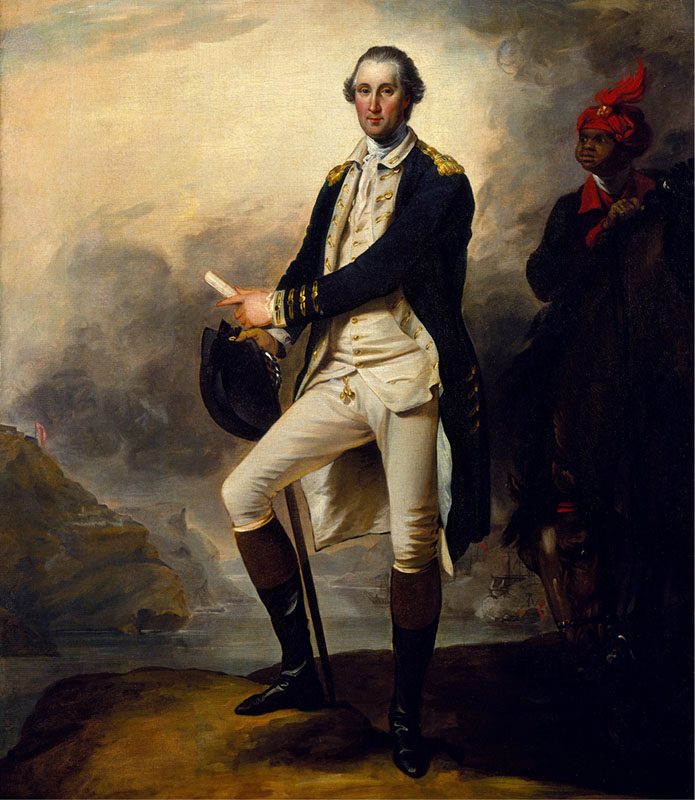
Figure 7.1 John Trumbull, Washington’s aide-de-camp, painted this wartime image of Washington on a promontory above the Hudson River. Just behind Washington, his slave William “Billy” Lee has his eyes firmly fixed on his master. In the far background, British warships fire on an American fort.
After the Revolutionary War, the ideology that “all men are created equal” failed to match up with reality, as the revolutionary generation could not solve the contradictions of freedom and slavery in the new United States. Trumbull’s 1780 painting of George Washington (Figure 7.1) hints at some of these contradictions. What attitude do you think Trumbull was trying to convey? Why did Trumbull include Washington’s slave Billy Lee, and what does Lee represent in this painting?
During the 1770s and 1780s, Americans took bold steps to define American equality. Each state held constitutional conventions and crafted state constitutions that defined how government would operate and who could participate in political life. Many elite revolutionaries recoiled in horror from the idea of majority rulea fundamental principle of democracy, providing that the majority should have the power to make decisions binding upon the whole—the basic principle of democracya system of government in which the majority rules—fearing that it would effectively create a “mob rule” that would bring about the ruin of the hard-fought struggle for independence. Statesmen everywhere believed that a republic should replace the British monarchya form of government with a monarch at its head: a government where the important affairs would be entrusted only to representative men of learning and refinement.