United States History · Chapter 25
25. Brother, Can You Spare a Dime? The Great Depression, 1929-1932
The chapter explains how the 1929 stock‑market crash triggered the Great Depression, detailing underlying economic weaknesses, speculative excesses, and subsequent bank failures, while describing the severe social hardships—unemployment, poverty, dust‑bowl devastation, and cultural shifts—that afflicted Americans; it also critiques President Hoover’s limited, individual‑ist response, his policies such as the Smoot‑Hawley Tariff and modest relief efforts, and notes how the era’s art, music, and film reflected both despair and a yearning for community.
Learning Objectives
By the end of this chapter, you will be able to:
- Identify the causes of the stock market crash of 1929
- Assess the underlying weaknesses in the economy that resulted in America’s spiraling from prosperity to depression so quickly
- Explain how a stock market crash might contribute to a nationwide economic disaster
- Explain Herbert Hoover’s responses to the Great Depression and how they reflected his political philosophy
- Identify the local, city, and state efforts to combat the Great Depression
- Analyze the frustration and anger that a majority of Americans directed at Herbert Hoover
- Identify the challenges that everyday Americans faced as a result of the Great Depression and analyze the government’s initial unwillingness to provide assistance
- Explain the particular challenges that African Americans faced during the crisis
- Identify the unique challenges that farmers in the Great Plains faced during this period
- Identify the successes and failures of Herbert Hoover’s presidency
- Determine the fairness and accuracy of assessments of Hoover’s presidency
Introduction#
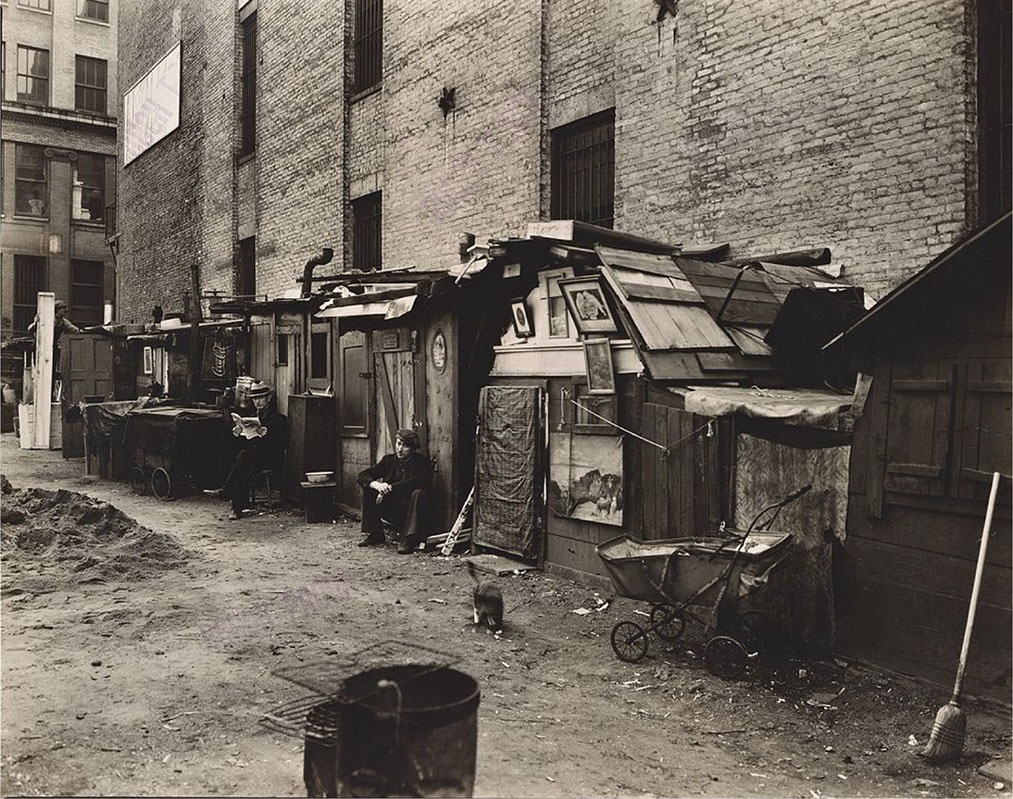
On March 4, 1929, at his presidential inauguration, Herbert Hoover stated, “I have no fears for the future of our country. It is bright with hope.” Most Americans shared his optimism. They believed that the prosperity of the 1920s would continue, and that the country was moving closer to a land of abundance for all. Little could Hoover imagine that barely a year into his presidency, shantytowns known as “Hoovervilles” would emerge on the fringes of most major cities (Figure 25.1), newspapers covering the homeless would be called “Hoover blankets,” and pants pockets, turned inside-out to show their emptiness, would become “Hoover flags.”
The stock market crash of October 1929 set the Great Depression into motion, but other factors were at the root of the problem, propelled onward by a series of both human-made and natural catastrophes. Anticipating a short downturn and living under an ethos of free enterprise and individualism, Americans suffered mightily in the first years of the Depression. As conditions worsened and the government failed to act, they grew increasingly desperate for change. While Hoover could not be blamed for the Great Depression, his failure to address the nation’s hardships would remain his legacy.