Early Mobilization and War
In 1861, enthusiasm for war ran high on both sides. The North fought to restore the Union, which Lincoln declared could never be broken. The Confederacy, which by the summer of 1861 consisted of eleven states, fought for its independence from the United States. The continuation of slavery was a central issue in the war, of course, although abolitionism and western expansion also played roles, and Northerners and Southerners alike flocked eagerly to the conflict. Both sides thought it would be over quickly. Militarily, however, the North and South were more equally matched than Lincoln had realized, and it soon became clear that the war effort would be neither brief nor painless. In 1861, Americans in both the North and South romanticized war as noble and positive. Soon the carnage and slaughter would awaken them to the horrors of war.
THE FIRST BATTLE OF BULL RUN#
After the fall of Fort Sumter on April 15, 1861, Lincoln called for seventy-five thousand volunteers from state militias to join federal forces. His goal was a ninety-day campaign to put down the Southern rebellion. The response from state militias was overwhelming, and the number of Northern troops exceeded the requisition. Also in April, Lincoln put in place a naval blockade of the South, a move that gave tacit recognition of the Confederacy while providing a legal excuse for the British and the French to trade with Southerners. The Confederacy responded to the blockade by declaring that a state of war existed with the United States. This official pronouncement confirmed the beginning of the Civil War. Men rushed to enlist, and the Confederacy turned away tens of thousands who hoped to defend the new nation.
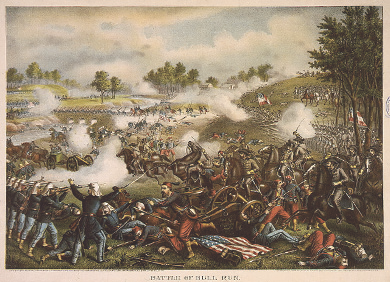
Many believed that a single, heroic battle would decide the contest. Some questioned how committed Southerners really were to their cause. Northerners hoped that most Southerners would not actually fire on the American flag. Meanwhile, Lincoln and military leaders in the North hoped a quick blow to the South, especially if they could capture the Confederacy’s new capital of Richmond, Virginia, would end the rebellion before it went any further. On July 21, 1861, the two armies met near Manassas, Virginia, along Bull Run Creek, only thirty miles from Washington, DC. So great was the belief that this would be a climactic Union victory that many Washington socialites and politicians brought picnic lunches to a nearby area, hoping to witness history unfolding before them. At the First Battle of Bull Run, also known as First Manassas, some sixty thousand troops assembled, most of whom had never seen combat, and each side sent eighteen thousand into the fray. The Union forces attacked first, only to be pushed back. The Confederate forces then carried the day, sending the Union soldiers and Washington, DC, onlookers scrambling back from Virginia and destroying Union hopes of a quick, decisive victory. Instead, the war would drag on for four long, deadly years (Figure 15.7).
BALANCE SHEET: THE UNION AND THE CONFEDERACY#
As it became clearer that the Union would not be dealing with an easily quashed rebellion, the two sides assessed their strengths and weaknesses. At the onset on the war, in 1861 and 1862, they stood as relatively equal combatants.
The Confederates had the advantage of being able to wage a defensive war, rather than an offensive one. They had to protect and preserve their new boundaries, but they did not have to be the aggressors against the Union. The war would be fought primarily in the South, which gave the Confederates the advantages of the knowledge of the terrain and the support of the civilian population. Further, the vast coastline from Texas to Virginia offered ample opportunities to evade the Union blockade. And with the addition of the Upper South states, especially Virginia, North Carolina, Tennessee, and Arkansas, the Confederacy gained a much larger share of natural resources and industrial might than the Deep South states could muster.
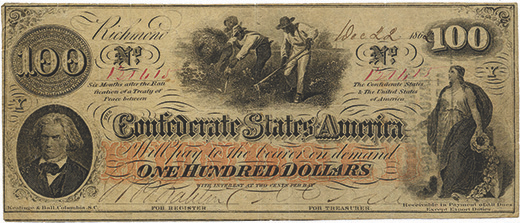
Still, the Confederacy had disadvantages. The South’s economy depended heavily on the export of cotton, but with the naval blockade, the flow of cotton to England, the region’s primary importer, came to an end. The blockade also made it difficult to import manufactured goods. Although the secession of the Upper South added some industrial assets to the Confederacy, overall, the South lacked substantive industry or an extensive railroad infrastructure to move men and supplies. To deal with the lack of commerce and the resulting lack of funds, the Confederate government began printing paper money, leading to runaway inflation (Figure 15.8). The advantage that came from fighting on home territory quickly turned to a disadvantage when Confederate armies were defeated and Union forces destroyed Southern farms and towns, and forced Southern civilians to take to the road as refugees. Finally, the population of the South stood at fewer than nine million people, of whom nearly four million were black slaves, compared to over twenty million residents in the North. These limited numbers became a major factor as the war dragged on and the death toll rose.
The Union side held many advantages as well. Its larger population, bolstered by continued immigration from Europe throughout the 1860s, gave it greater manpower reserves to draw upon. The North’s greater industrial capabilities and extensive railroad grid made it far better able to mobilize men and supplies for the war effort. The Industrial Revolution and the transportation revolution, beginning in the 1820s and continuing over the next several decades, had transformed the North. Throughout the war, the North was able to produce more war materials and move goods more quickly than the South. Furthermore, the farms of New England, the Mid-Atlantic, the Old Northwest, and the prairie states supplied Northern civilians and Union troops with abundant food throughout the war. Food shortages and hungry civilians were common in the South, where the best land was devoted to raising cotton, but not in the North.
Unlike the South, however, which could hunker down to defend itself and needed to maintain relatively short supply lines, the North had to go forth and conquer. Union armies had to establish long supply lines, and Union soldiers had to fight on unfamiliar ground and contend with a hostile civilian population off the battlefield. Furthermore, to restore the Union—Lincoln’s overriding goal, in 1861—the United States, after defeating the Southern forces, would then need to pacify a conquered Confederacy, an area of over half a million square miles with nearly nine million residents. In short, although it had better resources and a larger population, the Union faced a daunting task against the well-positioned Confederacy.
MILITARY STALEMATE#
The military forces of the Confederacy and the Union battled in 1861 and early 1862 without either side gaining the upper hand. The majority of military leaders on both sides had received the same military education and often knew one another personally, either from their time as students at West Point or as commanding officers in the Mexican-American War. This familiarity allowed them to anticipate each other’s strategies. Both sides believed in the use of concentrated armies charged with taking the capital city of the enemy. For the Union, this meant the capture of the Confederate capital in Richmond, Virginia, whereas Washington, DC, stood as the prize for Confederate forces. After hopes of a quick victory faded at Bull Run, the months dragged on without any major movement on either side (Figure 15.9).
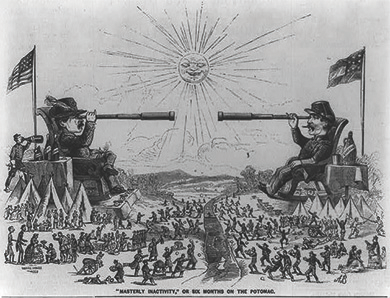
General George B. McClellan, the general in chiefThe commander of army land forces of the army, responsible for overall control of Union land forces, proved especially reluctant to engage in battle with the Confederates. In direct command of the Army of the Potomac, the Union fighting force operating outside Washington, DC, McClellan believed, incorrectly, that Confederate forces were too strong to defeat and was reluctant to risk his troops in battle. His cautious nature made him popular with his men but not with the president or Congress. By 1862, however, both President Lincoln and the new Secretary of War Edwin Stanton had tired of waiting. The Union put forward a new effort to bolster troop strength, enlisting one million men to serve for three-year stints in the Army of the Potomac. In January 1862, Lincoln and Stanton ordered McClellan to invade the Confederacy with the goal of capturing Richmond.
To that end, General McClellan slowly moved 100,000 soldiers of the Army of the Potomac toward Richmond but stopped a few miles outside the city. As he did so, a Confederate force led by Thomas “Stonewall” Jackson moved north to take Washington, DC. To fend off Jackson’s attack, somewhere between one-quarter and one-third of McClellan’s soldiers, led by Major General Irvin McDowell, returned to defend the nation’s capital, a move that Jackson hoped would leave the remaining troops near Richmond more vulnerable. Having succeeding in drawing off a sizable portion of the Union force, he joined General Lee to launch an attack on McClellan’s remaining soldiers near Richmond. From June 25 to July 1, 1862, the two sides engaged in the brutal Seven Days Battles that killed or wounded almost twenty thousand Confederate and ten thousand Union soldiers. McClellan’s army finally returned north, having failed to take Richmond.
General Lee, flush from his success at keeping McClellan out of Richmond, tried to capitalize on the Union’s failure by taking the fighting northward. He moved his forces into northern Virginia, where, at the Second Battle of Bull Run, the Confederates again defeated the Union forces. Lee then pressed into Maryland, where his troops met the much larger Union forces near Sharpsburg, at Antietam Creek. The ensuing one-day battle on September 17, 1862, led to a tremendous loss of life. Although there are varying opinions about the total number of deaths, eight thousand soldiers were killed or wounded, more than on any other single day of combat. Once again, McClellan, mistakenly believing that the Confederate troops outnumbered his own, held back a significant portion of his forces. Lee withdrew from the field first, but McClellan, fearing he was outnumbered, refused to pursue him.
The Union army’s inability to destroy Lee’s army at Antietam made it clear to Lincoln that McClellan would never win the war, and the president was forced to seek a replacement. Lincoln wanted someone who could deliver a decisive Union victory. He also personally disliked McClellan, who referred to the president as a “baboon” and a “gorilla,” and constantly criticized his decisions. Lincoln chose General Ambrose E. Burnside to replace McClellan as commander of the Army of the Potomac, but Burnside’s efforts to push into Virginia failed in December 1862, as Confederates held their position at Fredericksburg and devastated Burnside’s forces with heavy artillery fire. The Union’s defeat at Fredericksburg harmed morale in the North but bolstered Confederate spirits. By the end of 1862, the Confederates were still holding their ground in Virginia. Burnside’s failure led Lincoln to make another change in leadership, and Joseph “Fighting Joe” Hooker took over command of the Army of the Potomac in January 1863.
General Ulysses S. Grant’s Army of the WestThe Union fighting force operating in Kentucky, Tennessee, and the Mississippi River Valley, operating in Kentucky, Tennessee, and the Mississippi River Valley, had been more successful. In the western campaign, the goal of both the Union and the Confederacy was to gain control of the major rivers in the west, especially the Mississippi. If the Union could control the Mississippi, the Confederacy would be split in two. The fighting in this campaign initially centered in Tennessee, where Union forces commanded by Grant pushed Confederate troops back and gained control of the state. The major battle in the western theater took place at Pittsburgh Landing, Tennessee, on April 6 and 7, 1862. Grant’s army was camped on the west side of the Tennessee River near a small log church called Shiloh, which gave the battle its name. On Sunday morning, April 6, Confederate forces under General Albert Sidney Johnston attacked Grant’s encampment with the goal of separating them from their supply line on the Tennessee River and driving them into the swamps on the river’s western side, where they could be destroyed. Union general William Tecumseh Sherman tried to rally the Union forces as Grant, who had been convalescing from an injured leg when the attack began and was unable to walk without crutches, called for reinforcements and tried to mount a defense. Many of Union troops fled in terror.
Unfortunately for the Confederates, Johnston was killed on the afternoon of the first day. Leadership of the Southern forces fell to General P. G. T. Beauregard, who ordered an assault at the end of that day. This assault was so desperate that one of the two attacking columns did not even have ammunition. Heavily reinforced Union forces counterattacked the next day, and the Confederate forces were routed. Grant had maintained the Union foothold in the western part of the Confederacy. The North could now concentrate on its efforts to gain control of the Mississippi River, splitting the Confederacy in two and depriving it of its most important water route.
In the spring and summer of 1862, the Union was successful in gaining control of part of the Mississippi River. In April 1862, the Union navy under Admiral David Farragut fought its way past the forts that guarded New Orleans and fired naval guns upon the below-sea-level city. When it became obvious that New Orleans could no longer be defended, Confederate major general Marshall Lovell sent his artillery upriver to Vicksburg, Mississippi. Armed civilians in New Orleans fought the Union forces that entered the city. They also destroyed ships and military supplies that might be used by the Union. Upriver, Union naval forces also bombarded Fort Pillow, forty miles from Memphis, Tennessee, a Southern industrial center and one of the largest cities in the Confederacy. On June 4, 1862, the Confederate defenders abandoned the fort. On June 6, Memphis fell to the Union after the ships defending it were destroyed.
1863: The Changing Nature of the War#
Wars have their own logic; they last far longer than anyone anticipates at the beginning of hostilities. As they drag on, the energy and zeal that marked the entry into warfare often wane, as losses increase and people on both sides suffer the tolls of war. The American Civil War is a case study of this characteristic of modern war.
Although Northerners and Southerners both anticipated that the battle between the Confederacy and the Union would be settled quickly, it soon became clear to all that there was no resolution in sight. The longer the war continued, the more it began to affect life in both the North and the South. Increased need for manpower, the issue of slavery, and the ongoing challenges of keeping the war effort going changed the way life on both sides as the conflict progressed.
MASS MOBILIZATION#
By late 1862, the course of the war had changed to take on the characteristics of total warA state of war in which the government makes no distinction between military and civilian targets, and mobilizes all resources, extending its reach into all areas of citizens' lives, in which armies attempt to demoralize the enemy by both striking military targets and disrupting their opponent’s ability to wage war through destruction of their resources. In this type of war, armies often make no distinction between civilian and military targets. Both the Union and Confederate forces moved toward total war, although neither side ever entirely abolished the distinction between military and civilian. Total war also requires governments to mobilize all resources, extending their reach into their citizens’ lives as never before. Another reality of war that became apparent in 1862 and beyond was the influence of combat on the size and scope of government. Both the Confederacy and the Union governments had to continue to grow in order to manage the logistics of recruiting men and maintaining, feeding, and equipping an army.
Confederate Mobilization#
The Confederate government in Richmond, Virginia, exercised sweeping powers to ensure victory, in stark contradiction to the states’ rights sentiments held by many Southern leaders. The initial emotional outburst of enthusiasm for war in the Confederacy waned, and the Confederate government instituted a military draft in April 1862. Under the terms of the draft, all men between the ages of eighteen and thirty-five would serve three years. The draft had a different effect on men of different socioeconomic classes. One loophole permitted men to hire substitutes instead of serving in the Confederate army. This provision favored the wealthy over the poor, and led to much resentment and resistance. Exercising its power over the states, the Confederate Congress denied state efforts to circumvent the draft.
In order to fund the war, the Confederate government also took over the South’s economy. The government ran Southern industry and built substantial transportation and industrial infrastructure to make the weapons of war. Over the objections of slaveholders, it impressed slaves, seizing these workers from their owners and forcing them to work on fortifications and rail lines. Concerned about the resistance to and unhappiness with the government measures, in 1862, the Confederate Congress gave President Davis the power to suspend the writ of habeas corpusThe right of those arrested to be brought before a judge or court to determine whether there is cause to hold the prisoner, the right of those arrested to be brought before a judge or court to determine whether there is cause to hold the prisoner. With a stated goal of bolstering national security in the fledgling republic, this change meant that the Confederacy could arrest and detain indefinitely any suspected enemy without giving a reason. This growth of the Confederate central government stood as a glaring contradiction to the earlier states’ rights argument of pro-Confederate advocates.
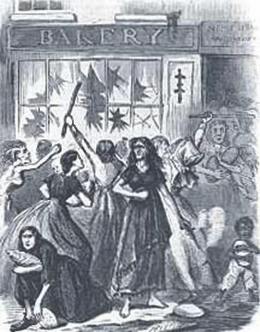
The war efforts were costing the new nation dearly. Nevertheless, the Confederate Congress heeded the pleas of wealthy plantation owners and refused to place a tax on slaves or cotton, despite the Confederacy’s desperate need for the revenue that such a tax would have raised. Instead, the Confederacy drafted a taxation plan that kept the Southern elite happy but in no way met the needs of the war. The government also resorted to printing immense amounts of paper money, which quickly led to runaway inflation. Food prices soared, and poor, white Southerners faced starvation. In April 1863, thousands of hungry people rioted in Richmond, Virginia (Figure 15.10). Many of the rioters were mothers who could not feed their children. The riot ended when President Davis threatened to have Confederate forces open fire on the crowds.
One of the reasons that the Confederacy was so economically devastated was its ill-advised gamble that cotton sales would continue during the war. The government had high hopes that Great Britain and France, which both used cotton as the raw material in their textile mills, would ensure the South’s economic strength—and therefore victory in the war—by continuing to buy. Furthermore, the Confederate government hoped that Great Britain and France would make loans to their new nation in order to ensure the continued flow of raw materials. These hopes were never realized. Great Britain in particular did not wish to risk war with the United States, which would have meant the invasion of Canada. The United States was also a major source of grain for Britain and an important purchaser of British goods. Furthermore, the blockade made Southern trade with Europe difficult. Instead, Great Britain, the major consumer of American cotton, found alternate sources in India and Egypt, leaving the South without the income or alliance it had anticipated.
Dissent within the Confederacy also affected the South’s ability to fight the war. Confederate politicians disagreed over the amount of power that the central government should be allowed to exercise. Many states’ rights advocates, who favored a weak central government and supported the sovereignty of individual states, resented President Davis’s efforts to conscript troops, impose taxation to pay for the war, and requisition necessary resources. Governors in the Confederate states often proved reluctant to provide supplies or troops for the use of the Confederate government. Even Jefferson Davis’s vice president Alexander Stephens opposed conscription, the seizure of slave property to work for the Confederacy, and suspension of habeas corpus. Class divisions also divided Confederates. Poor whites resented the ability of wealthy slaveholders to excuse themselves from military service. Racial tensions plagued the South as well. On those occasions when free blacks volunteered to serve in the Confederate army, they were turned away, and enslaved African Americans were regarded with fear and suspicion, as whites whispered among themselves about the possibility of slave insurrections.
Union Mobilization#
Mobilization for war proved to be easier in the North than it was in the South. During the war, the federal government in Washington, DC, like its Southern counterpart, undertook a wide range of efforts to ensure its victory over the Confederacy. To fund the war effort and finance the expansion of Union infrastructure, Republicans in Congress drastically expanded government activism, impacting citizens’ everyday lives through measures such as new types of taxation. The government also contracted with major suppliers of food, weapons, and other needed materials. Virtually every sector of the Northern economy became linked to the war effort.
In keeping with their longstanding objective of keeping slavery out of the newly settled western territories, the Republicans in Congress (the dominant party) passed several measures in 1862. First, the Homestead Act provided generous inducements for Northerners to relocate and farm in the West. Settlers could lay claim to 160 acres of federal land by residing on the property for five years and improving it. The act not only motivated free-labor farmers to move west, but it also aimed to increase agricultural output for the war effort. The federal government also turned its attention to creating a transcontinental railroad to facilitate the movement of people and goods across the country. Congress chartered two companies, the Union Pacific and the Central Pacific, and provided generous funds for these two businesses to connect the country by rail.
The Republican emphasis on free labor, rather than slave labor, also influenced the 1862 Land Grant College Act, commonly known as the Morrill Act after its author, Vermont Republican senator Justin Smith Morrill. The measure provided for the creation of agricultural colleges, funded through federal grants, to teach the latest agricultural techniques. Each state in the Union would be granted thirty thousand acres of federal land for the use of these institutions of higher education.
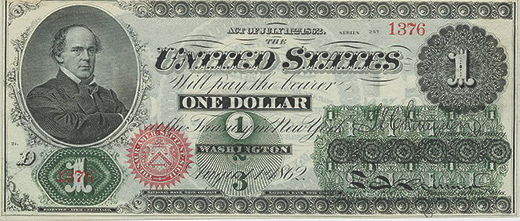
Congress paid for the war using several strategies. They levied a tax on the income of the wealthy, as well as a tax on all inheritances. They also put high tariffs in place. Finally, they passed two National Bank Acts, one in 1863 and one in 1864, calling on the U.S. Treasury to issue war bonds and on Union banks to buy the bonds. A Union campaign to convince individuals to buy the bonds helped increase sales. The Republicans also passed the Legal Tender Act of 1862, calling for paper money—known as greenbacksPaper money the United States began to issue during the Civil War—to be printed Figure 15.11). Some $150 million worth of greenbacks became legal tender, and the Northern economy boomed, although high inflation also resulted.
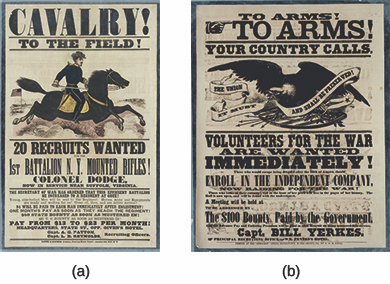
Like the Confederacy, the Union turned to conscription to provide the troops needed for the war. In March 1863, Congress passed the Enrollment Act, requiring all unmarried men between the ages of twenty and twenty-five, and all married men between the ages of thirty-five and forty-five—including immigrants who had filed for citizenship—to register with the Union to fight in the Civil War. All who registered were subject to military service, and draftees were selected by a lottery system (Figure 15.12). As in the South, a loophole in the law allowed individuals to hire substitutes if they could afford it. Others could avoid enlistment by paying $300 to the federal government. In keeping with the Supreme Court decision in Dred Scott v. Sandford, African Americans were not citizens and were therefore exempt from the draft.
Like the Confederacy, the Union also took the step of suspending habeas corpus rights, so those suspected of pro-Confederate sympathies could be arrested and held without being given the reason. Lincoln had selectively suspended the writ of habeas corpus in the slave state of Maryland, home to many Confederate sympathizers, in 1861 and 1862, in an effort to ensure that the Union capital would be safe. In March 1863, he signed into law the Habeas Corpus Suspension Act, giving him the power to detain suspected Confederate operatives throughout the Union. The Lincoln administration also closed down three hundred newspapers as a national security measure during the war.
In both the North and the South, the Civil War dramatically increased the power of the belligerent governments. Breaking all past precedents in American history, both the Confederacy and the Union employed the power of their central governments to mobilize resources and citizens.
Women’s Mobilization#
As men on both sides mobilized for the war, so did women. In both the North and the South, women were forced to take over farms and businesses abandoned by their husbands as they left for war. Women organized themselves into ladies’ aid societies to sew uniforms, knit socks, and raise money to purchase necessities for the troops. In the South, women took wounded soldiers into their homes to nurse. In the North, women volunteered for the United States Sanitary Commission, which formed in June 1861. They inspected military camps with the goal of improving cleanliness and reducing the number of soldiers who died from disease, the most common cause of death in the war. They also raised money to buy medical supplies and helped with the injured. Other women found jobs in the Union army as cooks and laundresses. Thousands volunteered to care for the sick and wounded in response to a call by reformer Dorothea Dix, who was placed in charge of the Union army’s nurses. According to rumor, Dix sought respectable women over the age of thirty who were “plain almost to repulsion in dress” and thus could be trusted not to form romantic liaisons with soldiers. Women on both sides also acted as spies and, disguised as men, engaged in combat.
EMANCIPATION#
Early in the war, President Lincoln approached the issue of slavery cautiously. While he disapproved of slavery personally, he did not believe that he had the authority to abolish it. Furthermore, he feared that making the abolition of slavery an objective of the war would cause the border slave states to join the Confederacy. His one objective in 1861 and 1862 was to restore the Union.
Since the beginning of the war, thousands of slaves had fled to the safety of Union lines. In May 1861, Union general Benjamin Butler and others labeled these refugees from slavery contrabandsSlaves who escaped to the Union army's lines. Butler reasoned that since Southern states had left the United States, he was not obliged to follow federal fugitive slave laws. Slaves who made it through the Union lines were shielded by the U.S. military and not returned to slavery. The intent was not only to assist slaves but also to deprive the South of a valuable source of manpower.
Congress began to define the status of these ex-slaves in 1861 and 1862. In August 1861, legislators approved the Confiscation Act of 1861, empowering the Union to seize property, including slaves, used by the Confederacy. The Republican-dominated Congress took additional steps, abolishing slavery in Washington, DC, in April 1862. Congress passed a second Confiscation Act in July 1862, which extended freedom to runaway slaves and those captured by Union armies. In that month, Congress also addressed the issue of slavery in the West, banning the practice in the territories. This federal law made the 1846 Wilmot Proviso and the dreams of the Free-Soil Party a reality. However, even as the Union government took steps to aid individual slaves and to limit the practice of slavery, it passed no measure to address the institution of slavery as a whole.
Lincoln moved slowly and cautiously on the issue of abolition. His primary concern was the cohesion of the Union and the bringing of the Southern states back into the fold. However, as the war dragged on and many thousands of contrabands made their way north, Republicans in Congress continued to call for the end of slavery. Throughout his political career, Lincoln’s plans for former slaves had been to send them to Liberia. As late as August 1862, he had hoped to interest African Americans in building a colony for former slaves in Central America, an idea that found favor neither with black leaders nor with abolitionists, and thus was abandoned by Lincoln. Responding to Congressional demands for an end to slavery, Lincoln presented an ultimatum to the Confederates on September 22, 1862, shortly after the Confederate retreat at Antietam. He gave the Confederate states until January 1, 1863, to rejoin the Union. If they did, slavery would continue in the slave states. If they refused to rejoin, however, the war would continue and all slaves would be freed at its conclusion. The Confederacy took no action. It had committed itself to maintaining its independence and had no interest in the president’s ultimatum.
On January 1, 1863, Lincoln made good on his promise and signed the Emancipation ProclamationSigned on January 1, 1863, the document with which President Lincoln transformed the Civil War into a struggle to end slavery. It stated “That on the first day of January, in the year of our Lord one thousand eight hundred and sixty-three, all persons held as slaves within any State or designated part of a State, the people whereof shall then be in rebellion against the United States, shall be then, thenceforward, and forever free.” The proclamation did not immediately free the slaves in the Confederate states. Although they were in rebellion against the United States, the lack of the Union army’s presence in such areas meant that the president’s directive could not be enforced. The proclamation also did not free slaves in the border states, because these states were not, by definition, in rebellion. Lincoln relied on his powers as commander-in-chief in issuing the Emancipation Proclamation. He knew the proclamation could be easily challenged in court, but by excluding the territories still outside his control, slaveholders and slave governments could not sue him. Moreover, slave states in the Union, such as Kentucky, could not sue because the proclamation did not apply to them. Slaveholders in Kentucky knew full well that if the institution were abolished throughout the South, it would not survive in a handful of border territories. Despite the limits of the proclamation, Lincoln dramatically shifted the objective of the war increasingly toward ending slavery. The Emancipation Proclamation became a monumental step forward on the road to changing the character of the United States.
The proclamation generated quick and dramatic reactions. The news created euphoria among slaves, as it signaled the eventual end of their bondage. Predictably, Confederate leaders raged against the proclamation, reinforcing their commitment to fight to maintain slavery, the foundation of the Confederacy. In the North, opinions split widely on the issue. Abolitionists praised Lincoln’s actions, which they saw as the fulfillment of their long campaign to strike down an immoral institution. But other Northerners, especially Irish, working-class, urban dwellers loyal to the Democratic Party and others with racist beliefs, hated the new goal of emancipation and found the idea of freed slaves repugnant. At its core, much of this racism had an economic foundation: Many Northerners feared competing with emancipated slaves for scarce jobs.
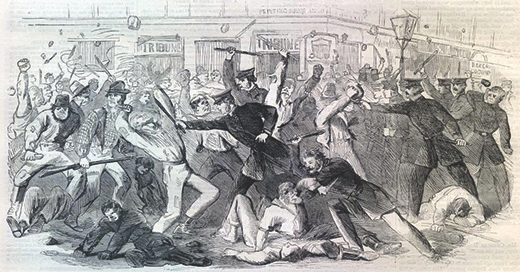
In New York City, the Emancipation Proclamation, combined with unhappiness over the Union draft, which began in March 1863, fanned the flames of white racism. Many New Yorkers supported the Confederacy for business reasons, and, in 1861, the city’s mayor actually suggested that New York City leave the Union. On July 13, 1863, two days after the first draft lottery took place, this racial hatred erupted into violence. A volunteer fire company whose commander had been drafted initiated a riot, and the violence spread quickly across the city. The rioters chose targets associated either with the Union army or with African Americans. An armory was destroyed, as was a Brooks Brothers’ store, which supplied uniforms to the army. White mobs attacked and killed black New Yorkers and destroyed an African American orphanage (Figure 15.13). On the fourth day of the riots, federal troops dispatched by Lincoln arrived in the city and ended the violence. Millions of dollars in property had been destroyed. More than one hundred people died, approximately one thousand were left injured, and about one-fifth of the city’s African American population fled New York in fear.
UNION ADVANCES#
The war in the west continued in favor of the North in 1863. At the start of the year, Union forces controlled much of the Mississippi River. In the spring and summer of 1862, they had captured New Orleans—the most important port in the Confederacy, through which cotton harvested from all the Southern states was exported—and Memphis. Grant had then attempted to capture Vicksburg, Mississippi, a commercial center on the bluffs above the Mississippi River. Once Vicksburg fell, the Union would have won complete control over the river. A military bombardment that summer failed to force a Confederate surrender. An assault by land forces also failed in December 1862.
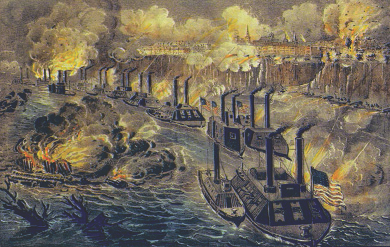
In April 1863, the Union began a final attempt to capture Vicksburg. On July 3, after more than a month of a Union siege, during which Vicksburg’s residents hid in caves to protect themselves from the bombardment and ate their pets to stay alive, Grant finally achieved his objective. The trapped Confederate forces surrendered. The Union had succeeded in capturing Vicksburg and splitting the Confederacy (Figure 15.14). This victory inflicted a serious blow to the Southern war effort.
As Grant and his forces pounded Vicksburg, Confederate strategists, at the urging of General Lee, who had defeated a larger Union army at Chancellorsville, Virginia, in May 1863, decided on a bold plan to invade the North. Leaders hoped this invasion would force the Union to send troops engaged in the Vicksburg campaign east, thus weakening their power over the Mississippi. Further, they hoped the aggressive action of pushing north would weaken the Union’s resolve to fight. Lee also hoped that a significant Confederate victory in the North would convince Great Britain and France to extend support to Jefferson Davis’s government and encourage the North to negotiate peace.
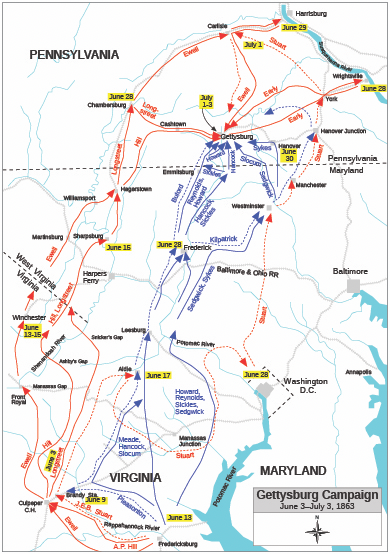
Beginning in June 1863, General Lee began to move the Army of Northern Virginia north through Maryland. The Union army—the Army of the Potomac—traveled east to end up alongside the Confederate forces. The two armies met at Gettysburg, Pennsylvania, where Confederate forces had gone to secure supplies. The resulting battle lasted three days, July 1–3 (Figure 15.15) and remains the biggest and costliest battle ever fought in North America. The climax of the Battle of Gettysburg occurred on the third day. In the morning, after a fight lasting several hours, Union forces fought back a Confederate attack on Culp’s Hill, one of the Union’s defensive positions. To regain a perceived advantage and secure victory, Lee ordered a frontal assault, known as Pickett’s Charge (for Confederate general George Pickett), against the center of the Union lines on Cemetery Ridge. Approximately fifteen thousand Confederate soldiers took part, and more than half lost their lives, as they advanced nearly a mile across an open field to attack the entrenched Union forces. In all, more than a third of the Army of Northern Virginia had been lost, and on the evening of July 4, Lee and his men slipped away in the rain. General George Meade did not pursue them. Both sides suffered staggering losses. Total casualties numbered around twenty-three thousand for the Union and some twenty-eight thousand among the Confederates. With its defeats at Gettysburg and Vicksburg, both on the same day, the Confederacy lost its momentum. The tide had turned in favor of the Union in both the east and the west.
Following the Battle of Gettysburg, the bodies of those who had fallen were hastily buried. Attorney David Wills, a resident of Gettysburg, campaigned for the creation of a national cemetery on the site of the battlefield, and the governor of Pennsylvania tasked him with creating it. President Lincoln was invited to attend the cemetery’s dedication. After the featured orator had delivered a two-hour speech, Lincoln addressed the crowd for several minutes. In his speech, known as the Gettysburg AddressA speech by Abraham Lincoln dedicating the military cemetery at Gettysburg on November 19, 1863, which he had finished writing while a guest in David Wills’ home the day before the dedication, Lincoln invoked the Founding Fathers and the spirit of the American Revolution. The Union soldiers who had died at Gettysburg, he proclaimed, had died not only to preserve the Union, but also to guarantee freedom and equality for all.